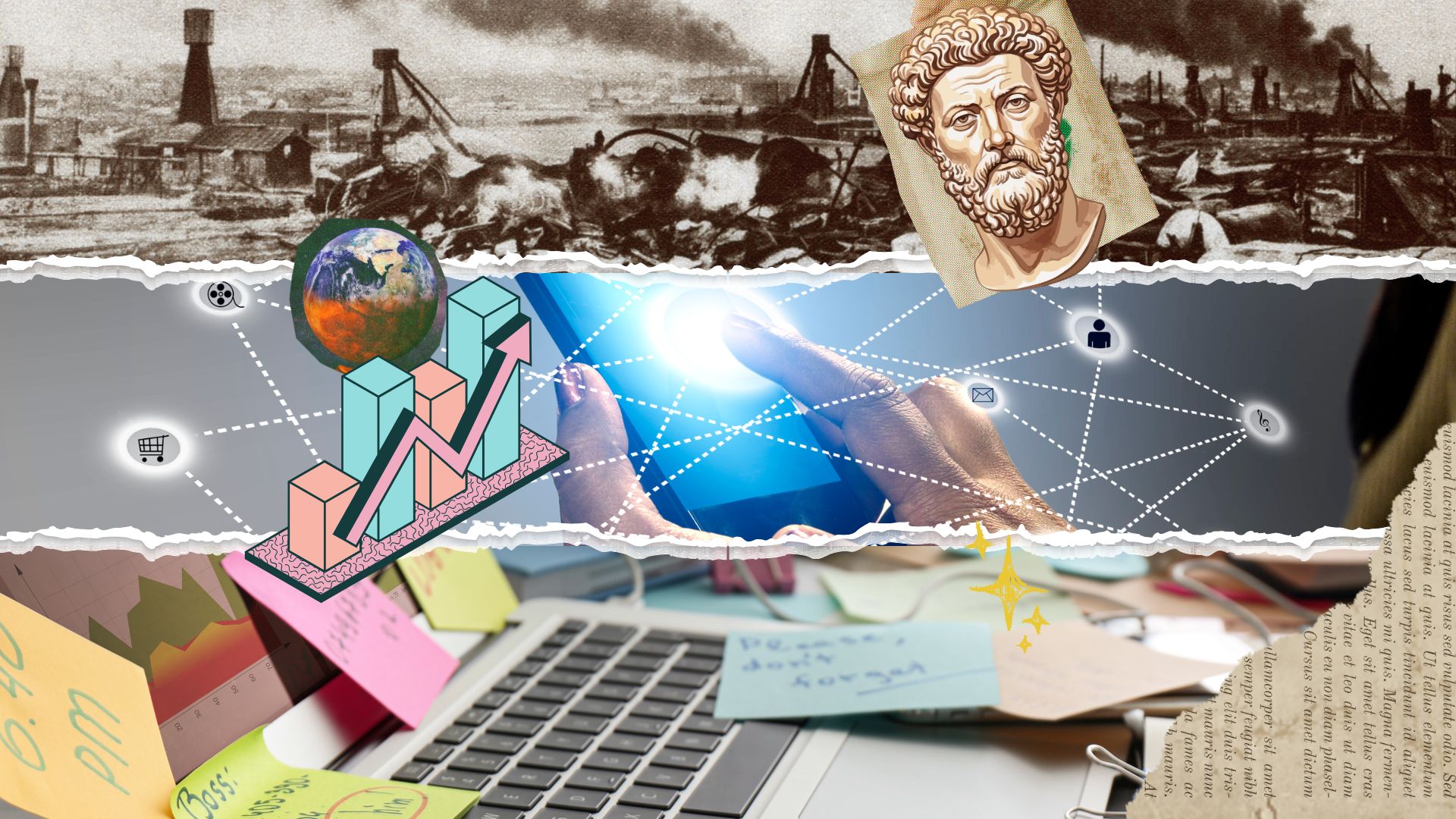
A political human condition that we can feel but don’t quite know how to name. When every other news headline speaks of disaster, conflict, death, war, etc. how are we meant to react?
Humans evolved under conditions distinct to modern ones. Knowing the happenings of the world at this level of instant detail is a quite new phenomenon. Hundreds of years ago local populations may have found out about a foreign war only long after it had concluded as the message was sent by boat to empires. Now just scroll on the magical phone-box for one minute and we’re suddenly empathizing with people we will never meet in our lifetime, with lands we have never touched. This is the new normal.
Imagine back in the day, not even go so far… before radios and after newspapers. Newpapers were considered insanely fast for knowing current events, printed daily and we barely considered the 24 hour wait time. Wake up, read the news while eating breakfast, then go about your day at work, come home, eat, sleep, repeat. Now put news livestreams and international conflict exposure in between all of those activities, with a buffer of 30 seconds to a couple hours if you have the self control to not look at The Phone.
This can create a feeling of constant crisis. The problem is that humans have evolved in contexts with slower information exposure and local dangers. Our ‘hardware’ is still programmed to alert when a predator is nearby in the wild, yet with 2026 software that tells us to worry about every specific foreign current event as if it were our own.
One point of debate in that line of thought is processing in communities. Depending on your stance regarding modern technology, this could be a lost tradition, or our original software on super-mode. Globalization and technology now allow us to connect with international communities in minutes if not seconds, we should be able to complete this necessity for communal processing better than before. But do we? On the pessimistic side of things, algorithms and platform dynamics can trick us into thinking we’re alone in our experience. When only the extremes show up in the feed; influencers buying million dollar houses, wars continuing around the world— the ‘normal’ day to day human experience starts to feel alien and more unique than it actually is.
Highlight reels show the best-of followed by the worst-of human experience. That sets up a trap of ‘I could be more successful’ but also ‘I could be worse off’. Ultimately the feeling often concludes in invalidation, desperation, and hopelessness. That’s exhausting.
From that exhaustion, we mentally disengage yet can’t seem to put the phone down. Once we’re broken down emotionally and the feed keeps scrolling, advertisements are conveniently placed. Not just as a conspiracy, there is research that shows how marketing algorithms are strategic. They optimize for interaction, and engagement naturally peaks when we are emotionally vulnerable.
Pair this marketing with the crisis feed saturation and what’s left is a power strategy; an emotionally exhausted public is less politically participative (Tandoc et al., 2022). Side effects include but are not limited to: internalized apathy from necessity, and excessive anxiety labeled as awareness.
On top of that, we can see the globalization of fear. International headlines heat up (January 2026), suddenly influencers from the Netherlands are sharing the pamphlets sent by their government outlining how to prepare for emergencies. The first reaction is ‘oh no! We’re preparing for world war three!’. Then, if your pattern recognition fires up, it starts to feel like the Covid pandemic ‘panic scarcity’ (David et al., 2021). They tell us there will be conflict, and therefore, we must prepare through consumption. Buy everything you might need, they say, toilet paper, water, food. Humans are generally empathetic creatures, and that empathy is being exploited.
Side note: What’s even more interesting as I look into these sources is that the Dutch government was planning since November of 2025 (Pascoe, 2025) to send out these emergency guides, yet they appear on social media as if it were a direct reaction to current events.
If we were never meant to know this much, but knowing this much is now unavoidable, how are we supposed to manage? Is apathy the correct answer to protect our empathy? Empathizing with every crisis on earth is not sustainable nor healthy. Enter empathy and we inherit fear; if the Dutch government is preparing for crisis, we should be too, right? Then before your YouTube video even plays, starved children from Gaza appear in high resolution asking for your support. The empathetic heart does a flip-flop and suddenly ‘free Palestine’ comments flood irrelevant videos as if symbolic participation in the digital space will result in physical political change.
This is where apathy starts to look appealing (as an idealist, it hurts me to admit the reality). Considering it as a coping mechanism, not an ideal solution. With a healthy dose of apathy we realize, the Dutch government is a foreign region, and those suffering children on YouTube are a representation of conflict, our donations do not go directly to the faces we see.
As a theoretical contrast, esoterically, gurus and philosophers argue that we are all one, one humanity on one planet. That would be the solution to world peace logically, if all of the world’s citizens woke up one day with pure empathy… wars would end and governments would talk about their problems until finding a solution instead of running back to the arms race. Considering the international legal system is based on good faith, this should be the solution. Should, the doomed word of an optimist.
So we find ourselves at the most horrific crossroads; empathy and exploitation.
Humans have empathy, though being aware of all of empathy’s functions and implications is less common if not impossible. This leaves a moral power vacuum that can turn the masses emotions into an economic and political chessboard. Empathy has led us to exhaustion instead of inspiring new solutions.
What links globalized panic, emotional ad targeting, and crisis discourse seems to be less coincidental and more of a structural alignment. Crisis news is embedded in our algorithms and optimized for guiding our attention and fatigue towards consumption. In this modern digital environment, empathy becomes a key player in extractive world systems and our fear is a scalable factor in the economic supply chain.
To retake our emotional sovereignty is no easy task. Pure apathy isn’t the solution, but incomplete empathy is unsustainable. Reactive engagement only perpetuates the cycle when we’re constantly fatigued by crisis exposure.
This is where you’d think the article turns into a ‘put down your phone’ and ‘touch grass’ advice, but that’s out of place and simply not viable for modern daily life. Healthy relationships encourage boundaries; based on that, our relationship with smartphones (and crisis news headlines) is structurally toxic.
Maybe the goal isn’t to feel more or to feel less about tragic daily happenings, maybe we’re meant to relearn how to feel on our own terms and how to create healthy mental boundaries.
Remembering that we are built for finite responsibility, whenever a headline or reel sparks panic and despair we could take note and double check; is this my fear to feel? Is there action I can take? If the answer is no, invite Stoic philosophy to revive itself and reenter the conversation.
As said by Marcus Aurelius, “You have power over your mind — not outside events. Realize this, and you will find strength.”
References
- Tandoc, E. C., & Kim, H. K. (2022). Avoiding real news, believing in fake news? Investigating pathways from information overload to misbelief. Journalism, 24(6), 1174–1192. https://doi.org/10.1177/14648849221090744
- Hawkins, S., Yudkin, D., Juan-Torres, M., & Dixon, T. (2008). Hidden Tribes: A Study of America’s Polarized Landscape. More in Common. https://hiddentribes.us/media/qfpekz4g/hidden_tribes_report.pdf
- Howarth, J. (2026, January 12). How many people own smartphones? (2025-2029). Exploding Topics. https://explodingtopics.com/blog/smartphone-stats
- Wu, T. (2017, April 14). The crisis of attention Theft—Ads that steal your time for nothing in return. WIRED. https://www.wired.com/2017/04/forcing-ads-captive-audience-attention-theft-crime/
- David, J., Visvalingam, S., & Norberg, M. M. (2021). Why did all the toilet paper disappear? Distinguishing between panic buying and hoarding during COVID-19. Psychiatry Research, 303, 114062. https://doi.org/10.1016/j.psychres.2021.114062
- Pascoe, R. (2025, November 18). Government to deliver emergency guide to all households – DutchNews.nl. DutchNews.nl. https://www.dutchnews.nl/2025/11/government-to-deliver-emergency-guide-to-all-households/
- Otamendi, F. J., & Martín, D. L. S. (2020). The emotional effectiveness of advertisement. Frontiers in Psychology, 11, 2088. https://doi.org/10.3389/fpsyg.2020.02088
- Online, E. (2026, January 3). Quote of the day by Marcus Aurelius: ’You have power over your mind – not outside events. Realize this, an. The Economic Times. https://m.economictimes.com/magazines/panache/quote-of-the-day-by-marcus-aurelius-you-have-power-over-your-mind-not-outside-events-realize-this-and-you-will-find-strength/articleshow/126215537.cms







No responses yet