
Category-Theoretic Openings in Quantum IR
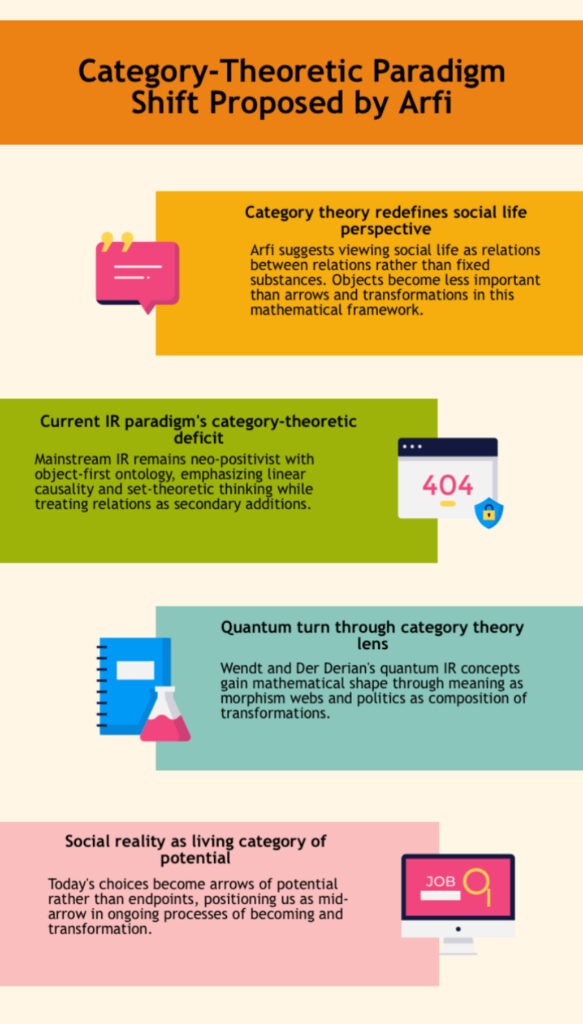
Chapter 11 of Quantum International Relations invites social theories to change perspective. Drawing on category theory, Badredine Arfi suggests that we can view social life not as fixed substances (states, leaders, borders) but as relations between relations.
Badredine Arfi is a professor of political science.
In category-theoretic language, the objects are less important than the arrows, the transformations themselves.
From an IR perspective this is quietly radical. It tells us that a treaty, a security dilemma, or a cultural exchange is not merely an interaction between pre-given actors. Each is an operation that redefines the very actors involved, a dynamic echo of quantum concepts like superposition and entanglement.
The Current Paradigm Through Arfi’s Category Lens
Arfi begins by diagnosing where International Relations still stands today.
Despite decades of critique, the dominant frame remains neo-positivist and substance-oriented. States, markets, and even “global civil society” are considered given objects that interact through measurable variables. In categorical terms, this is an object-first ontology: the emphasis is on stable “nodes” (states, institutions, agents) and on functions that merely transfer properties from one node to another.
Several features of this paradigm stand out:
- Linear Causality – Social science organizes around input-output chains. Events are explained as if arrows were one-way morphisms carrying pre-fixed attributes.
- Set-Theoretic Thinking – Actors are conceived as elements of sets with clear boundaries. Relations are secondary, something to be added after the fact.
- Representational Epistemology – Knowledge is seen as mirroring an external reality. Observers stand outside what they describe, rather than co-constituting it.
Arfi calls this the category-theoretic deficit of mainstream IR.
Category-theoretic Quantum Turn (Wendt & Der Derian)
Alexander Wendt and James Der Derian frame quantum IR around ideas such as observer effect, entanglement, and resonance.
Arfi’s category-theoretic move complements this by giving it mathematical shape:
- Meaning as a web of morphisms: language and identity emerge only within the total network (a “quantum holism” that Wendt highlights in his own discussion of language and meaning).
- Politics as composition of transformations: negotiations or conflicts are chains of morphisms, where each link changes the meaning of the next.
Seen together, these insights nudge us toward a diplomacy that is less about actions of “things” and more about processes of becoming.
Category-Theoretic Takeaway
If social reality is a living category, then today’s choices are not endpoints but arrows of potential, always capable of new composition.
For those of us building long projects (whether an index of global coherence or a personal creative adventure) that view is grounding. We are not late or early; we are simply mid-arrow, free to compose the next morphism.
References
- Arfi, B. (2022). Category-theoretic proposition of social theoretical approaches. In A. Wendt & J. Der Derian (Eds.), Quantum international relations: A human science for world politics (pp. [215-243]). Oxford University Press.
- Sydney, P. Q. (2021, 7 junio). Q2: Interview with Badredine Arfi. Project Q. https://projectqsydney.com/multimedia/q2-interview-with-badredine-arfi/
- Badredine Arfi | Department of Political Science. (s. f.). https://people.clas.ufl.edu/barfi/








No responses yet